You've spent years building your business. Revenue has grown, you've hired employees, established a customer base, and earned a reputation in your industry. On paper, you've built something valuable.
But there's a question that can change how you think about everything you've accomplished: What happens to the business when you're no longer running it?
If customers still expect to speak directly with you, major decisions require your approval, and your leadership team depends on you to keep projects moving, a buyer may see more risk than opportunity.
Understanding how to increase enterprise value starts with recognizing that a company's worth isn't determined by financial performance alone. It's also influenced by how consistently the business can perform without depending on its owner.
That's where business value creation becomes an operational priority, not just a financial objective.

What Is Enterprise Value, and Why Does It Matter?
Enterprise value is a measure of a company's total operating value. A common calculation adds the market value of equity and debt, then subtracts cash, with adjustments where appropriate.
For business owners, understanding enterprise value means looking beyond the calculation. Potential buyers want to know whether a company can continue producing results after ownership changes, how reliably it generates earnings, and what risks could threaten future performance.
Consider two hypothetical construction companies, each generating $10 million in annual revenue and $1 million in EBITDA.
Company A: The owner manages key customer relationships, approves significant purchases, resolves scheduling conflicts, and makes nearly every major operational decision.
Company B: The leadership team owns departmental results, project managers have clear decision-making authority, and repeatable processes guide daily operations.
Although their financial performance is identical, Company B may be more attractive to a buyer because its earnings appear less dependent on one individual. That doesn't guarantee a higher sale price. Industry conditions, customer concentration, growth prospects, and financial performance also influence valuation. As SCORE explains in its guide to business valuation, buyers consider both financial performance and the risks associated with owning a company.
Enterprise value depends on more than what your company earns today. It also depends on how confidently someone else can own and operate it tomorrow.
Curious where your company stands financially? Our free EBITDA Calculator can help you explore your earnings and potential business value.
The Core Problem: Your Business Still Needs You to Function
In the early stages of a business, being involved in everything is often necessary. You're selling the work, managing customers, solving problems, and making sure commitments are fulfilled. Your resourcefulness and willingness to take responsibility helped the company grow.
But what helped you build the business can eventually limit its ability to scale.
As the company expands, more employees, customers, projects, and decisions create greater complexity. If the owner remains at the center of that complexity, the business becomes increasingly dependent on one person's availability and judgment.
Over time, the owner becomes accustomed to making the decisions, and the leadership team becomes accustomed to waiting for them.
From a buyer's perspective, the concern is straightforward: How much of the company's current performance would remain if the owner stepped away?
A buyer isn't simply purchasing the company's history. They're evaluating its ability to produce future results.

Five Ways Owner Dependency Can Limit Enterprise Value
1. Critical Decisions Still Depend on the Owner
When every meaningful decision requires the owner's involvement, the company has a limited ability to operate independently. A project manager might need approval before addressing a customer issue, or a department leader might wait for the owner to make a hiring decision.
Individually, these situations seem manageable. Together, they create a business where progress slows whenever the owner is unavailable.
The opportunity is to develop leaders with clear responsibilities, appropriate decision-making authority, and accountability for results. The goal isn't to remove the owner from every important decision, but to ensure routine operations can continue without constant intervention.
For a deeper look at identifying these bottlenecks, read our guide on how to reduce owner dependency in your business.
2. Daily Firefighting Prevents Meaningful Progress
An urgent customer issue, unexpected staffing shortage, or project delay can quickly consume an owner's day. Some problems are unavoidable, but when the same issues repeatedly require intervention, firefighting becomes part of how the business operates.
That leaves less time for leadership development, strategic planning, and the improvements that could make the company more valuable.
A buyer wants confidence that the company can identify problems, address their causes, and maintain consistent execution. If every week requires extraordinary effort to keep things moving, maintaining results after an ownership transition becomes more uncertain.
The opportunity is to identify recurring problems and establish clear processes and accountability for resolving them permanently.
3. The Leadership Team Doesn't Have Enough Shared Ownership
Hiring managers doesn't automatically create a leadership team capable of running a company.
A business can have experienced department heads and still depend on its owner to connect priorities, settle disagreements, and ensure commitments are completed. Sales makes promises without coordinating with operations, department leaders pursue competing priorities, and the owner becomes the person holding everything together.
That arrangement may work while the owner is actively involved, but it creates uncertainty about how the company will function after a transition.
The opportunity is to build leaders who understand shared business priorities, make decisions within clear authority, and take responsibility for measurable outcomes.
4. Plans and Meetings Don't Consistently Produce Results
A company can have a detailed strategic plan, regular leadership meetings, and ambitious growth targets without consistently making progress.
Priorities get discussed without clear ownership, action items lack deadlines, and the same problems return to the agenda month after month. Eventually, the owner steps in to push important initiatives forward.
This creates another form of dependency: The company can develop plans, but it relies on the owner to turn them into action.
The opportunity is to establish a disciplined approach to setting priorities, assigning responsibility, tracking progress, and following through. Leadership meetings should produce decisions and completed work, not simply more discussion.
If your team struggles to identify what matters or translate plans into execution, our free Business Clarity Checklist can help you identify where clarity is breaking down.
5. The Business Isn't Becoming Easier to Scale or Transfer
Growth and scalability are not the same thing.
A company can increase revenue while also increasing its dependence on the owner, creating more management complexity and adding operational inefficiencies.
If every new project requires more owner involvement and every new employee creates additional oversight, growth becomes increasingly difficult to sustain. Expanding into new markets, stepping back from operations, or preparing for an ownership transition all become more complicated.
The opportunity is to build the leadership capacity, repeatable processes, and organizational discipline needed to support growth without increasing owner dependency.

What Buyers Are Really Evaluating
Buyers assess financial performance alongside the risks associated with maintaining that performance. While every transaction is different, several operational characteristics can influence their confidence.
These characteristics help buyers assess how sustainable and transferable a company's earnings appear. A profitable business with significant owner dependency may require additional management investment, a longer transition period, or greater buyer protections.
For more on how buyers compare businesses using financial measures, the CFA Institute explains enterprise value multiples and their relationship to earnings, sales, and cash flow.
How to Increase Enterprise Value Through People, Process, and Priorities
If you're exploring how to increase enterprise value, improving operational independence is a practical place to start. A company that consistently delivers results without relying on its owner is building capabilities that can support growth, reduce risk, and make future ownership transitions more manageable.
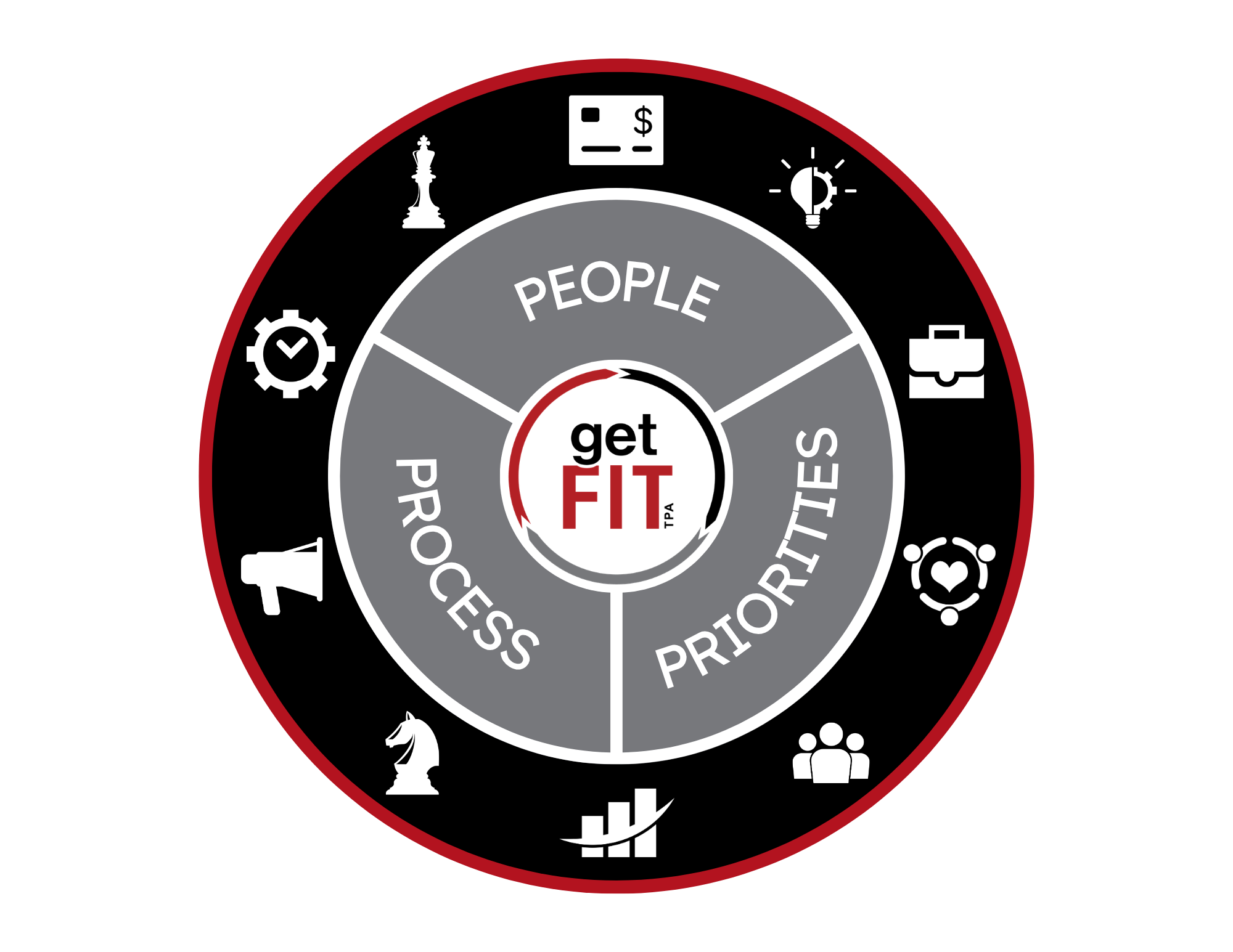
At Get TPA Fit, we call that capability Business Fitness — the ability to grow, scale, and perform consistently without dependency on the owner or any one person.
We focus on three interconnected areas that support long-term business value creation.
People: Build leaders who own results. Strong leadership requires clearly defined roles, decision-making authority, and accountability for measurable outcomes. When leaders consistently take ownership, the business can operate without the founder resolving every issue.
Process: Make consistent performance repeatable. Clear processes help teams deliver reliable results without reinventing how work gets done. The goal isn't complicated manuals or additional bureaucracy, but practical consistency that supports growth.
Priorities: Turn strategic decisions into completed work. Leadership teams need to agree on what matters, assign ownership, and measure progress. When follow-through becomes part of daily operations, the company becomes less dependent on the owner to create momentum.
Together, these areas strengthen a company's ability to scale and create transferable value.
A Practical Enterprise Value Readiness Check
You don't need to be preparing for a sale to evaluate how transferable your business has become.
Start by answering these six questions:
If you stepped away for 30 days, which decisions would stop moving? Identify responsibilities that still depend on your direct involvement.
Can your leadership team explain the company's top three priorities? Confirm that leaders understand what matters and how success is measured.
Do recurring operational problems get permanently resolved? Look for issues that repeatedly require the same interventions.
Can department leaders make sound decisions without escalating routine matters? Evaluate whether authority and accountability are clearly established.
Are important initiatives completed on schedule? Examine whether meetings and strategic plans reliably produce measurable progress.
Could a new owner understand how the business operates without relying on your personal knowledge? Consider the clarity of your processes, responsibilities, reporting, and customer relationships.
If several answers reveal continued owner dependency, you've identified opportunities to strengthen the business. You don't need to solve every issue at once. Start with the dependencies creating the greatest operational risk, assign clear ownership, and build the discipline to address them consistently.
Want a clearer picture of where your company still relies on you?
Download our free Owner Dependency Checklist to identify the bottlenecks limiting your ability to step back, scale, and build value.
You Don't Have to Sell Your Business to Benefit From Building Enterprise Value
Building a company someone would buy doesn't mean you have to sell it. It means creating a business with more options.
You might want to expand into new markets, pursue acquisitions, transition ownership to family members, or eventually sell to an outside buyer. You may simply want to spend less time managing daily problems while knowing the company can continue performing.
These goals share a common requirement: The business must become capable of operating beyond the owner.
At Get TPA Fit, our Business Fitness Accelerator helps owners and leadership teams strengthen leadership, improve accountability, reduce owner dependency, and build scalable and transferable value through a value-acceleration framework.
Because the ultimate goal isn't just to own a successful business. It's to build a company that can succeed without you — and one that someone else would be confident owning.
Schedule a Fit Discovery Call to explore what it would take to make your business more scalable, less owner-dependent, and more valuable.