
How to Improve Your Market Position in Your Construction Business
(Without Racing to the Bottom on Price)
By Preston True, Founder & Lead Advisor at Get TPA Fit
What “market position” actually means in construction
Market position is how the market explains you when you are not in the room.
Not what you claim.
What customers, architects, GCs, and subs expect will happen if they hire you.
Position is perception plus proof
In construction, perception is built by behaviors.
Do you start when you say you will start.
Do you communicate before problems become emergencies.
Do you close jobs cleanly or linger for weeks.
Proof is what supports that perception.
Project outcomes and before/after documentation.
Schedule and change-order performance.
References that describe specific behaviors.
If you compete on price, you already chose your position
Most construction businesses do not “end up” competing on price.
They choose it by default because they never installed a clear lane, a clean offer, and a delivery system that performs without heroics.
Improving your market position means you stop being interchangeable.
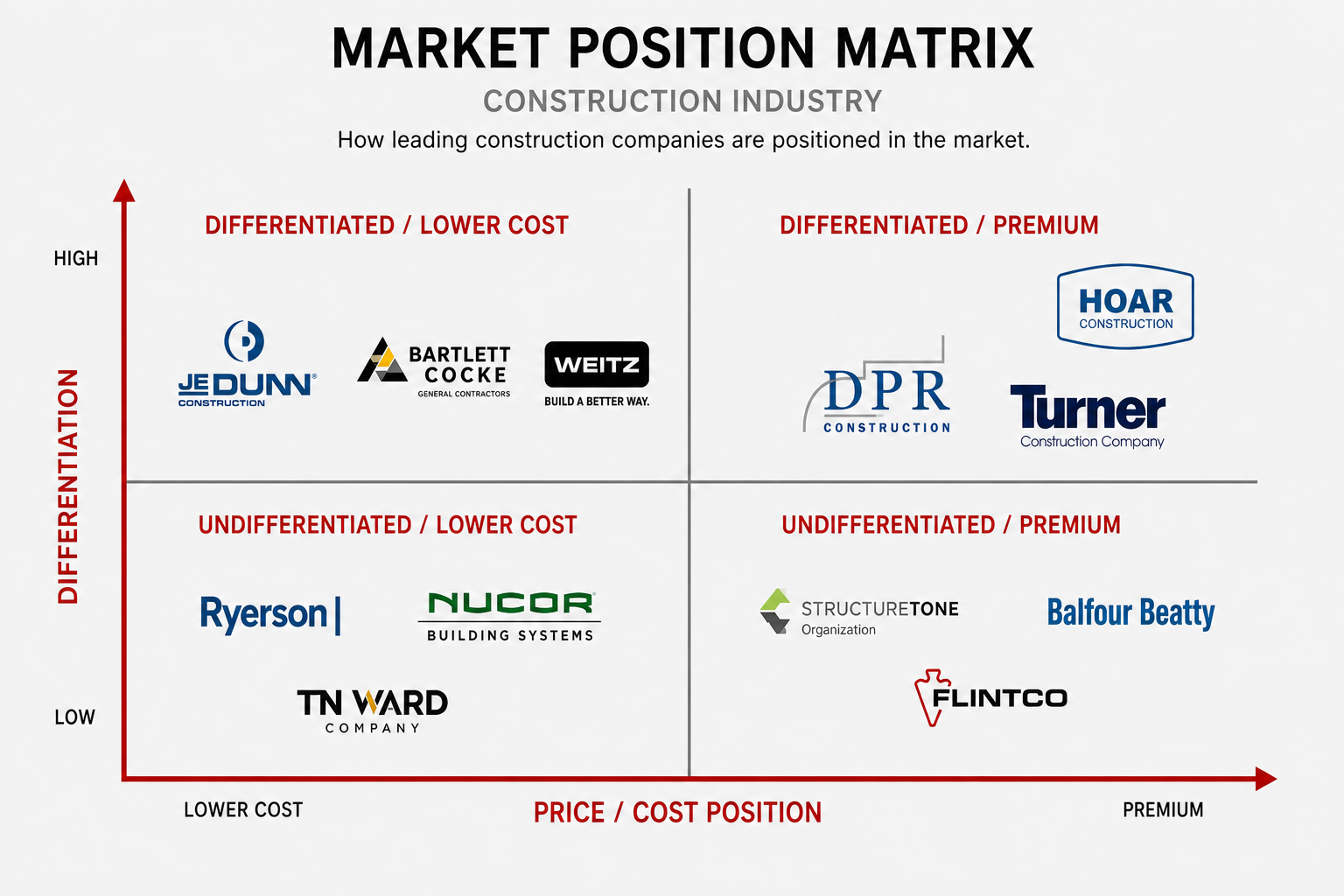
Simple diagram showing the relationship between market position, differentiation, and price for a construction company
Diagnose your current position in 30 minutes
You do not need a brand workshop.
You need facts.
Your last 10 wins and losses
Pull the last 10 bids or proposals that mattered.
Write down:
Project type and size range.
Who the buyer actually was.
Why you won or lost in plain language.
Patterns show up fast.
If you cannot name a pattern, your sales process is not capturing reality.
Where margin is coming from
Sort your last 12 months of completed jobs by gross margin.
Then ask:
Which jobs were operationally smooth.
Which jobs required owner rescue.
Which customer types paid fastest.
Your best market position usually sits where margin and operational control overlap.
Who sends you referrals and why
List the last 20 inbound referrals.
Tag each source:
Past client relationship referral.
Architect or engineer referral.
GC, developer, or property manager referral.
Then capture the reason in one sentence.
“They trust we document scope.”
“They trust we keep subs accountable.”
That sentence is your current position.

Choose a lane: niche, geography, project type, risk profile
If you are a $2M–$12M construction business, you cannot be everything to everyone.
Generalist messaging creates generalist results.
The niche selection filter
Use this filter to pick a lane you can win.
Repeatability: Similar scopes you can systemize and estimate cleanly.
Buyer clarity: You can name the buyer and their decision drivers.
Risk control: You can reduce unknowns through process and contracts.
Margin reality: The lane supports healthy gross margin without games.
Specialist beats generalist at $2M–$12M revenue
At this stage, your advantage is not scale.
Your advantage is focus and execution.
Specialists:
Estimate faster with fewer misses.
Build a recognizable proof trail.
Train foremen and PMs on repeatable playbooks.
Examples of strong construction positions
Schedule certainty: “We hit critical dates with disciplined planning and weekly owner reports.”
Occupied-space experts: “We renovate while tenants operate, with tight safety and communication.”
Fast-turn retail: “We deliver multi-site rollouts with consistent subs and closeout packs.”
High-compliance work: “We run documentation and QA like a system, not a scramble.”
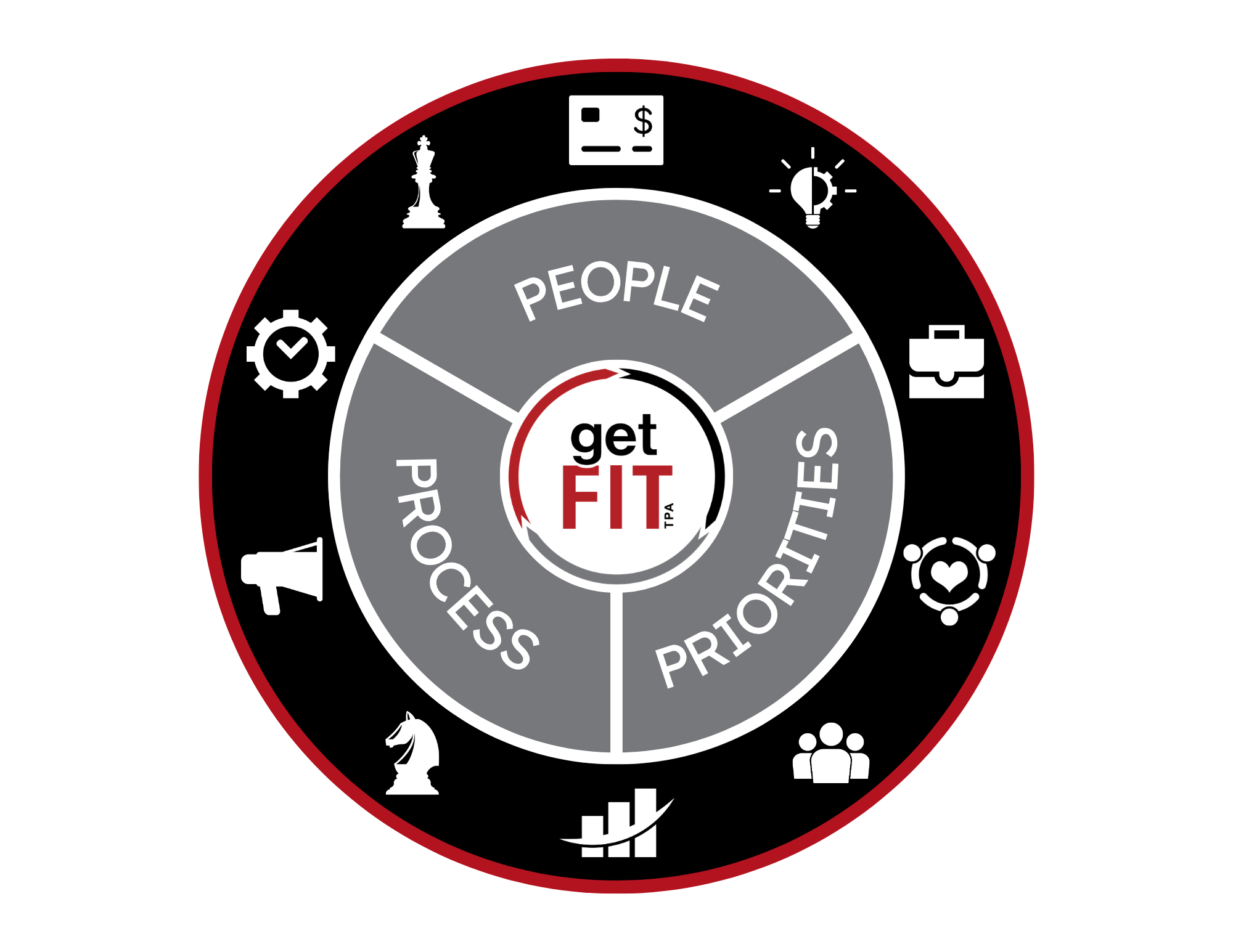
Build a position that sells: People, Process, Priorities
Your market position is not a tagline.
It is the outcome of your operating system.
We use a simple framework: People, Process, Priorities.
People: role clarity and field leadership
If your position requires reliability, your org chart cannot be imaginary.
Start here:
One owner for estimating outcomes and bid quality.
One owner for project delivery outcomes and schedule control.
One owner for closeout outcomes and punch list discipline.
If you cannot name who owns the outcome, you do not have clarity.
Process: predictable delivery and clean handoffs
Construction businesses lose position during handoffs.
Estimate to PM.
PM to superintendent.
Superintendent to closeout.
Install a simple operating process:
Pre-construction kickoff with scope, assumptions, and constraints documented.
Weekly job rhythm with schedule lookahead and constraint removal.
Change-order workflow with pricing timelines and approval checkpoints.
Priorities: 90-day focus that customers can feel
Most owners have goals.
They do not have priorities that change behavior this week.
Market position improves when you pick 1–3 priorities per quarter and execute them with discipline.
Reduce schedule variance on targeted project types.
Cut rework by tightening QA checklists.
Shorten closeout cycle time with a standard closeout pack.

Stop leaking trust: Fix the 5 reputation killers
Market position is fragile.
These five issues destroy it fast.
Scheduling fog and missed starts
Buyers will forgive a schedule change.
They will not forgive silence.
Standardize:
2-week lookahead published every week.
Constraint list with a named owner for each item.
Customer update sent on a fixed day and time.
Change orders that feel like surprises
Change orders are not the problem.
Surprise is the problem.
Document assumptions inside the proposal scope.
Price changes within a defined turnaround window.
Require written approval before work proceeds.
Bid packages with vague scope
Vague scope creates bid leveling fights and margin leaks.
Clean scope improves position because it signals professionalism.
Inclusions and exclusions listed in plain language.
Allowances and unit prices clearly defined.
Schedule assumptions stated up front.
Jobsite communication gaps
When the buyer cannot reach the right person, you look small.
Even if your revenue is not small.
Single point of contact with a published response standard.
Daily log discipline that captures decisions and blockers.
Meeting agenda that forces decisions and next actions.
Punch list chaos at closeout
Closeout is where referrals are earned.
Or lost.
Pre-punch walkthrough before the client walkthrough.
Closeout checklist owned by one person.
Final documentation delivered as a standard packet.

Your business should be approached with real strategy.
How to improve market penetration without buying more leads
Market penetration is how much of your chosen lane you actually capture.
The fastest way to improve it is not adding more channels.
It is owning one channel with discipline.
Dominate 1 referral channel at a time
Pick one of these and run it for 90 days:
Past-client reactivation and referral requests.
Architect and engineer relationship pipeline.
Property manager and facility director pipeline.
Weekly action wins.
Random coffee meetings do not.
Account-based outreach for repeatable buyers
Construction growth gets easier when you win repeatable buyers.
Create a target list of 25 accounts in your lane.
Then run a cadence:
Week 1: direct outreach with a clear point of view on risk and schedule.
Week 2: share a relevant project case summary with numbers.
Week 3: request a 15-minute introduction call with a specific ask.
Partnerships with architects, engineers, and GCs
Partners refer work to contractors who make them look good.
Position yourself around outcomes they care about:
Fewer RFIs due to cleaner scope and precon review.
Fewer client escalations due to predictable updates.
Fewer closeout disputes due to clean documentation.
Your “proof stack”: photos, numbers, and story
Proof needs to be packaged, not stored in someone’s phone.
Build a proof stack for your niche:
Before/after photos with scope notes and constraints.
Schedule performance: planned vs actual milestones.
Closeout speed: days from substantial completion to final close.

Price is not your strategy: create a value-based offer
If your offer is “we do great work,” you are a commodity.
Buyers assume everyone says that.
Offer architecture for contractors
Make the offer specific to the buyer’s risks.
Outcome: What gets built and what gets protected.
Process: How you control scope, schedule, and communication.
Boundaries: What you will not do and what triggers a change order.
Three tiers that protect margin
Tiering is not a gimmick.
It is clarity.
Base: Build plus standard weekly updates and closeout checklist.
Priority: Added precon review, tighter schedule reporting, faster change-order turnaround.
Partner: Highest-touch coordination, stakeholder meetings, and documentation package.
When you offer tiers, you stop negotiating your core standards.
Guarantees and boundaries that reduce risk
In construction, guarantees must be real and controllable.
Examples that can work when your process supports them:
Guaranteed change-order pricing turnaround time.
Guaranteed weekly update cadence and response window.
Guaranteed closeout packet delivery standard.
Do not promise what your team cannot execute repeatedly.

A 90-day plan to improve market position
Position improves when your execution rhythm improves.
Here is a clean 90-day plan.
Weeks 1–2: Clarify your position and message
Choose one lane with the niche selection filter.
Write a one-sentence position statement your team can repeat.
Update your proposals to reflect scope clarity and process proof.
Weeks 3–6: Tighten delivery and install meeting cadence
Meetings are not the problem.
Unstructured meetings are.
Install a weekly leadership meeting with a fixed agenda and scorecard.
Standardize job kickoff and weekly lookahead on every active project.
Define ownership for estimating, delivery, and closeout outcomes.
Weeks 7–10: Build proof and partner pipeline
Create 3 case summaries that match your lane and buyer type.
Build a 25-account list and run the outreach cadence weekly.
Ask for 5 referrals with a specific description of your lane.
Weeks 11–13: Review, decide, and lock the next quarter
Review win rate, margin, schedule performance, and closeout speed.
Decide what to stop doing that does not fit your position.
Set 1-year goals, then pick the next 90-day priorities.
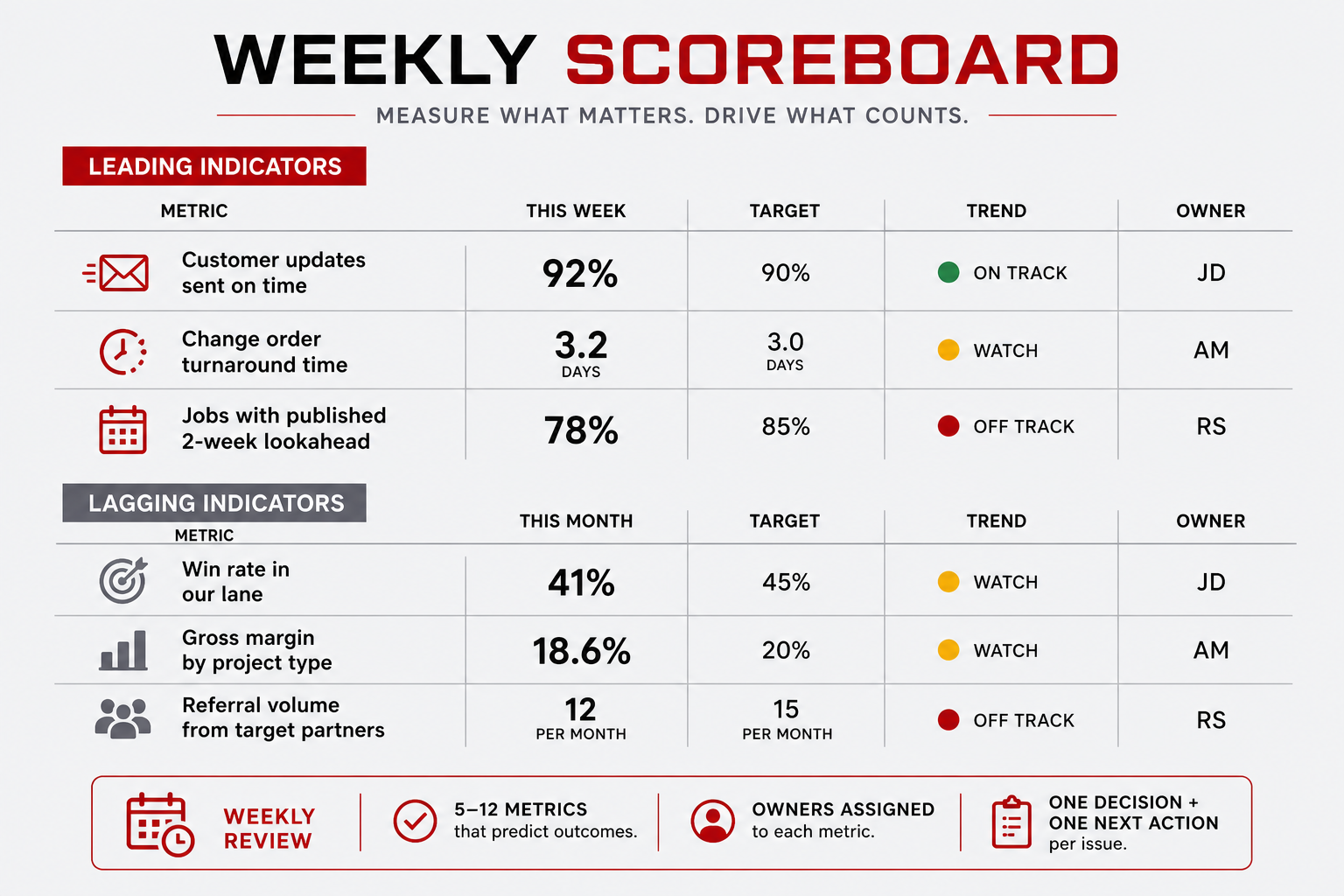
What to measure so you know it’s working
Position is a lagging result.
Track leading behaviors that create it.
Leading indicators
Number of proactive customer updates sent on time.
Change-order turnaround time in business days.
Percent of jobs with a published 2-week lookahead.
Lagging indicators
Win rate in your chosen lane.
Gross margin by project type.
Referral volume from target partners.
Scoreboard cadence for the leadership team
If the numbers only live in your head, you are the system.
That is owner dependency.
Run a weekly scoreboard review:
5–12 metrics that predict outcomes.
Owners assigned to each metric.
One decision and one next action per issue.

When you need help: The operating system that deletes chaos
Many construction owners try to “work harder” to improve market position.
That approach tops out.
What scales is a disciplined operating cadence.
What changes when the owner stops being the glue
Priorities stop drifting based on emergencies.
Meetings produce decisions and clear ownership.
Execution continues when the owner is off-site.
What a disciplined cadence looks like in practice
Our Business Fitness Accelerator is built for this.
Simple structure.
High-trust accountability.
Real execution.
90-minute mastermind cohort sessions that keep priorities moving.
Quarterly planning meetings that translate vision into 90-day priorities.
People, Process, Priorities framework so you fix the right thing first.
Next step for owners who want a sellable business in 3–6 years
If you want to improve your market position, start by choosing your lane and installing a 90-day rhythm.
If you want help doing it with discipline, we can show you the operating system and cadence we use with growth-minded owners.
Decide. Act. Clarity compounds.
Ready to take the next step in building a scalable, valuable (and ultimately, sellable) business? Our Business Fitness Accelerator program might be a right fit for you.
BOOK A FIT DISCOVERY CALL BELOW


Growing a business is exciting. More customers, more employees, and more opportunities are all signs that you're moving in the right direction. But growth also has a way of revealing problems that were easy to overlook when the company was smaller.